
Artificial intelligence (AI) has come a long way in a very short space of time. Some programs and tools that were cutting edge only a couple of years ago have already been eclipsed by more nuanced, powerful technologies arriving onto the market.
One of the most dramatic shifts taking place is the emergence of LLM powered AI agents, also referred to as agentic AI. According to research by McKinsey, in 2025 up to 62% of businesses are at least experimenting with AI agents in some capacity.
Not so long ago, software vendors would pitch programs capable of answering queries at a fairly rudimentary level. Now, AI agents are capable of accomplishing dozens of tasks across many departments within a business. Companies such as Salesforce, CoPilot Studio, and Intersect AI are building comprehensive AI ecosystems with tools and applications designed to integrate seamlessly with one another to achieve core business objectives.
This transition represents a massive leap in productivity. But it also raises the stakes. When AI moves from suggestion to execution, the risk profile and potential ROI increase in tandem.
In this article, we'll go into detail on what an AI agent is and how it works as well as the types of AI agents that are common within the business landscape. We'll highlight where and how AI agents create business value. And we'll round off with a breakdown of the risks associated with using these tools.
What is an AI Agent?
An AI agent is an application or tool built to solve a specific task using a language model as an internal control mechanism. Early iterations of AI programs followed predetermined scripts in order to arrive at given outcomes.
AI agents are more dynamic; they will receive a task and proactively pull data and context from company sources to fulfil the goal. They will take actions in service of that goal and can monitor the success of these actions before potentially revising their approach using a self-evaluation technique called reflection.
A useful analogy is to consider AI agents as equivalent to hard working intern within a human workforce. In the same way a business leader would not expect an intern to work on open-ended tasks, let alone rewrite a complex corporate strategy, AI agents are not a direct replacement for judgement-heavy work. However, an intern would be expected to coordinate well defined multi-step workflows to fulfill a specific task and reach a goal or outcome.
What's key to remember is that an AI agent is a system, not just a single tool, model, or application.
How Do AI Agents Compare to Other Operational Models?
As the market floods with AI terminology, it can be very easy to get caught in the trap of thinking that they all largely mean the same thing and can be used interchangeably. For a business leader, however, the differences between the various AI models are functionally and financially important. Knowing the key distinctions will help you to understand which type of tool you require.
Let's take a quick look at some of the other AI operational systems available to businesses to see how they differ from AI agents.
Chatbots
Chatbots are likely one of the first things people think of in relation to AI as they are now one of the most well-established forms of AI utilization. Chatbots are primarily conversational interfaces designed for a question and response approach, or simple routing to other resources.
Through retrieval augmentation (pointed at corporate knowledge bases) they can be customized for your requirements, producing content in line with your policies and style. Their main strength is their instant retrieval of company information and customer data to help customers and employees.
However, chatbots are very isolated tools. They can tell you how to do something, but they're not often able to do it for you.
Copilots
A copilot lives inside a specific application (such as a CRM) to assist with human-centric tasks. With this approach, the human often takes the lead to complete the task, with the AI providing operational assistance.
An example of a copilot in action could be the drafting of a marketing email that the human agent will then send out to customers, perhaps recognizing when the human worker has mistyped a reference to a particular company policy. The core idea is that the copilot lives within an application where the human does work, and assists them with that specific work.
Copilots are reactive rather than proactive, which is the main difference between this type of AI tool and fully-fledged AI agents.
Robotic Process Automation (RPA)
These types of tools are great for removing the need of humans to complete mundane, busy-body tasks throughout the day. They function using a straightforward 'if X, then Y' process. These tools can be used to conjoin multiple systems with different APIs, which is where they offer some similarity to agents.
However, their deterministic design means that they will stop functioning whenever inputs are changed. An RPA process cannot reason its way through an exception.
How AI Agents Work
Understanding how an AI agent works is important as it allows a business to decide where they will fit into the wider business infrastructure. Unlike traditional forms of software (that will generally follow a linear pathway), an AI agent operates in a continuous cycle of interpretation, planning, execution, and evaluation known as an agentic loop.
Broadly speaking, the process that AI agent will utilize is as follows:
- Sense: The agent ingests the request and gathers the necessary context pertaining to it. It will pull from dozens of different data sources in order to begin executing on its task.
- Think: The agent interprets the goal, breaks the process of achieving the goal into logical subsets, and decides which tools, datasets, and applications are required to move forward.
- Act: The agent executes on its chosen action by requesting execution of the necessary functions via APIs. An agentic system is empowered through the selection of tools at its disposal which it can combine in novel ways to achieve outcomes.
- Verify: The agent will then evaluate its own work. Sometimes using a different language model to evaluate the results produced by the first.
The Key Building Blocks of AI Agents
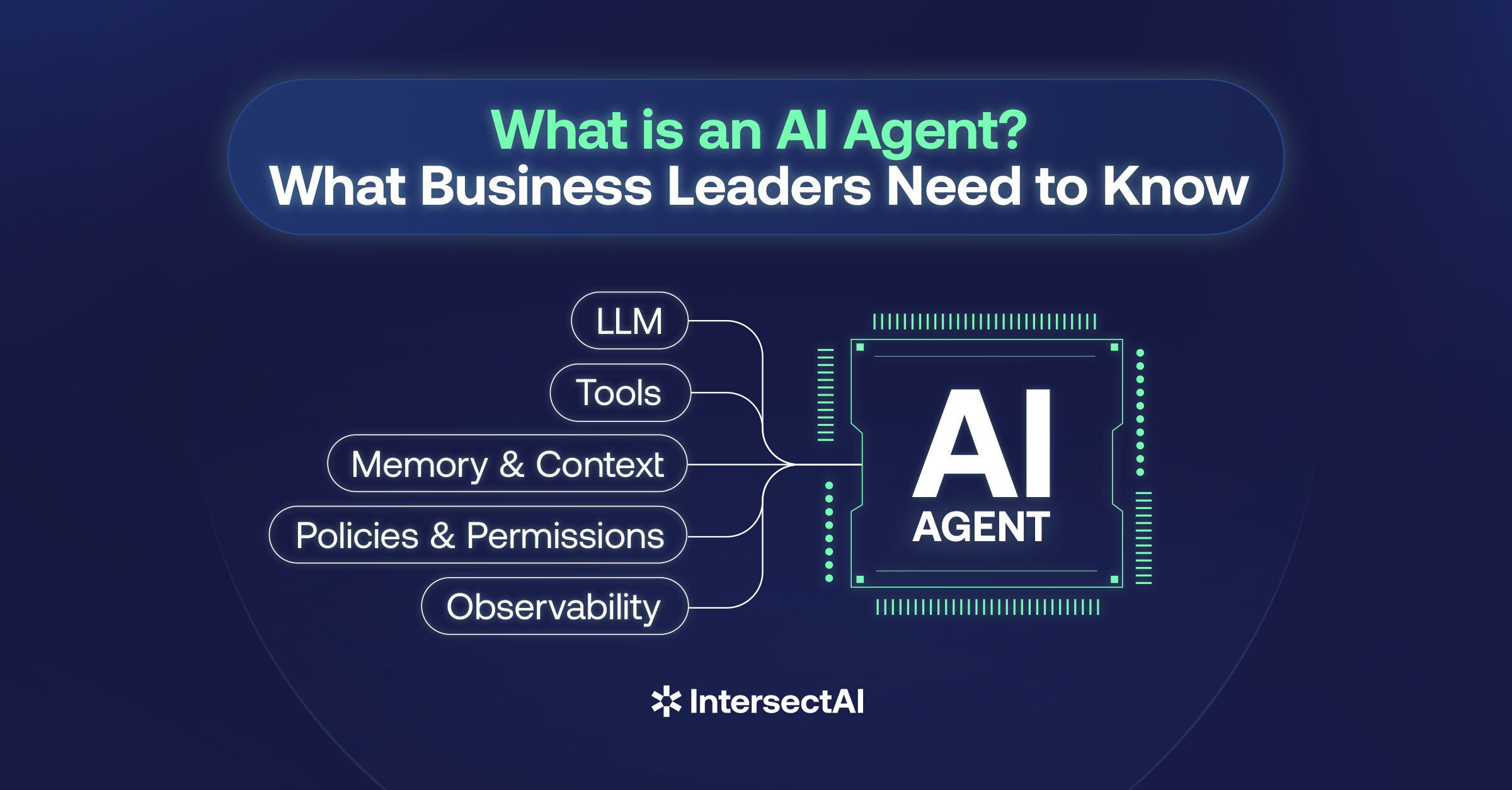
Every enterprise AI agent is composed of five essential components. As a leader, these are the levers you can pull to increase performance and safety.
- The Large Language Model (LLM): The language model acts as the engine that understands inputs, goals, information and context expressed in either natural language, or structured data like JSON. The language model is also used as a reasoning engine to plan the series of intermediate steps required to achieve a goal, including the marshalling of resources and tools.
- Tools: The tools define the action space of the agent. They are, in a sense, the 'hands' of the operation that facilitate things getting done. Tools can be custom built or imported from common libraries. Recent work includes protocols, like MCP, that make it easy to develop and deploy tools independently from the agents themselves.
- Memory & context: This includes both short-term memory (steps within a given task) and long-term memory (contextual data about a customer or client and past project outcomes). Modern techniques of context management involve building tools that manage the agent memory so they remain focused on the most important pieces of information.
- Policies & permissions: These are the guardrails, which are essential for a program's safety and security. The business must define what the agent cannot do. In addition, it should be determined how to identify and intervene in a workflow if an agent has strayed from the goal.
- Observability: Two key principles related to AI, in a broader sense, are accountability and explainability. This component of a program records logs and necessary audit trails for compliance, ensuring every decision the agent made is transparent and traceable.
Types of AI Agents Leaders Will Encounter
AI agents, ultimately, all serve the same purpose for a business. Their primary goal is to automate, streamline, and support business operations and the wider human workforce. However, it's important to note that within the wide variety of AI agents, there are specific types with specific roles that business leaders should be aware of if they're looking to create a truly integrated infrastructure.
Task agents
Task agents are often the quick, convenient wins within the AI world. They are generally designed for a single purpose or goal. Historically these tasks could be done with a single purpose, custom built machine learning model. These models were trained on task specific data, often from the company data warehouse, to ensure that they could do that one task really well. Language models unlock new kinds of task agents that require some form of language or document comprehension. Some good examples of task agents include drafting documents or emails according to company templates, compiling weekly reports, and classifying incoming support tickets.
Task agents are best utilized in highly-controlled environments where clean datasets and narrow goals allow them to complete the tasks without risk of hindrance, and with acceptable error rates. They are often a good starting point for smaller businesses who perhaps don't need complex systems.
Workflow agents
These types of agents take things a step on from task agents. They will still, usually, have a primary goal or task to accomplish contained within a single business department, but that goal is usually much broader in scope. The workflow typically consists of multiple stages, with corresponding decisions determining both the sequence and outcome. In the simplest example the workflow would be linear. In more complex scenarios, it will branch out to cover multiple potential pathways.
An onboarding agent is a good example of a simple linear workflow agent. There are multiple steps to the onboarding process when a new employee starts (background checks, IT setup, contract management etc.). However, they are often completed in a sequence, with some later steps depending on the results of previous steps. A workflow agent can be designed to execute certain steps, and coordinate with the employee to complete others. Ideally, such an agent will contain the rules and policies to ensure all steps are completed.
Multi-Agent Systems (Agentic AI)
The most complex designs for AI agent systems will involve multiple agents working in conjunction to achieve complex business operations. This design typically emerges when a single model fails to perform at an acceptable level on the individual tasks in a workflow, or when the tasks can be completed in parallel.
The ultimate goal of agentic AI is to manage complex, non-linear processes that may require reasoning and nuance in order to arrive at the most optimal outcome, without the need for human micromanagement.
Where AI Agents Create Business Value
The primary driver behind the value that AI agents bring to a business lies with their ability to reduce overhead costs through automation of repeated workflows, particularly those that require some understanding of document content. This change has seen the use of language models shift from passive, conversational tools, towards a more integrated infrastructure that handles end-to-end operations.
When AI agents are used in workflow automation the outcomes, and intermediate stages, are measurable and monitorable. They act as a connective tissue between business operations, ensuring that approvals are routed instantly, documentation is gathered efficiently, and hand-offs are not delayed by human work hours.
Where AI Agents Are a Poor Fit
However, as with all emerging technologies, AI agents are not the one-size-fits-everything solution to all business processes. There are some significant areas where they are either still developing, or where human intervention and oversight should be seen as the preferential option:
- Nuanced judgement: If the task involves judgments concerning human values or niche domain specific reasoning, then an AI agent may be unable to emulate the task.
- Human interaction. If the primary value of a business process is human-to-human interaction, for example in 'closing a deal,' then an AI agent may result in degraded performance.
- High-stakes decisions: The higher the stakes, the more stock a business is putting in its AI succeeding. Any action that carries legal, ethical, or compliance-related factors should remain within a human agent's remit.
High-Value Enterprise Use Cases
A solution isn't of much use to anyone until it has moved from the pilot or testing phase into becoming heavily involved with production within a real-world context.
AI agents (and agentic AI in a broader sense) are beginning to show real signs of this transition taking effect, leading to tangible benefits for the business.
Let's take a look at some examples of where agents are delivering measurable cycle-time reductions:
- Procurement & vendor approvals: When a request comes in, the agent validates it against the current budget policies and gathers missing tax documentation from the vendor. It then routes the complete package to the right signatory, complete with clear audit trails, ready for a human agent to sign it off.
- Security operation (SecOps) triage: The agent will gather initial threat detectors and log them into the system by checking them against existing databases. It will open tickets whenever it receives an alert that triggers any security protocols (informed by company policies), and escalates only high-risk situations to human-led teams.
- Sales: The agent will scan the social media accounts of competitors as part of its market research. It will use predictive lead scoring to determine which leads are 'hot' and likely to lead to sales. It may draft and schedule email drip campaigns and update customer accounts on CRMs whenever there is interaction.
Risks Associated With AI Agents
When an AI agent moves from basic language and retrieval tasks to goal-oriented execution, the consequences of errors and mistakes grow larger. Managing an agentic workforce doesn't come without risk and requires a shift in focus from traditional segmented IT oversight to a much broader digital governance.
Some of the most common risks include:
- Permission creep: An AI agent may inadvertently retrieve data from sources it has no need to access if security protocols aren't robust.
- Prompt injection: Bad actors can hijack an AI's logic patterns by crafting deliberately malicious prompts and actions.
- Reasoning loops: Without adequate guardrails an AI Agent can get stuck in costly reasoning loops where sub-agents feed off each other endlessly, slowing systems down and increasing compute costs.
- Model drift: AI tools are not immune to degradation. As datasets become outdated, so too can the AI responses.
- Accountability gaps: Businesses can fall foul of becoming over-reliant on AI technology to the point where there is no clear accountability should things go wrong.
Final Thoughts
The shift to agentic AI is opening an opportunity to automate tasks that were previously impervious to automation. We are rapidly moving past task-based and workflow agents and towards systems that are capable of cross-department functionality and execution.
For the modern business leader, the advantages are clear. Operational consistency, faster delivery speeds, and the removal of human error are all great perks that the technology brings. However, it is a form of AI that is still in its infancy. Business leaders will carefully balance risk and reward if they want to gain the most out of agentic AI solutions.
FAQs
What's the difference between an AI agent and a chatbot?
A chatbot is primarily focused on offering responses to customer queries by retrieving information and answering questions based on a script or database. An AI agent is designed to act rather than just respond; it contains an internal structure that allows it to plan a series of steps and execute them to complete a goal or objective, often through interaction with multiple agents.
Do AI agents replace human employees?
While some entry-level, high volume repetitive roles are being phased out, it is much more common to see AI agents augment human employees' output rather than replace them outright. Many AI applications still require considerable human-in-the-loop inputs. And employees are now often spending time as orchestrators rather than simple task-doers.
What data systems do we need before deploying an agent?
AI agents are more effective when your business systems are composed of micro-services that expose very specific APIs. Your company knowledge bases should be fully up-to-date and accurate. Finally, you should have a fine-grained security model that will allow you to clearly control what the agents can and cannot do. This way you ensure agents are only accessing what they need in order to complete their objectives.
How do we measure ROI from agents?
Some of the key metrics to monitor when determining potential ROI on AI agents include reductions in work process cycle time and an improved percentage of task success rates. You can look for a reduction in hand-off times, an increase in total throughput rates. Longer term, you can evaluate the ratio at which your revenues and costs are scaling together. Agentic workforces should allow your costs to scale at a lower ratio to revenues.