Built Around Your Existing Tools and Infrastructure

The ROI Gap

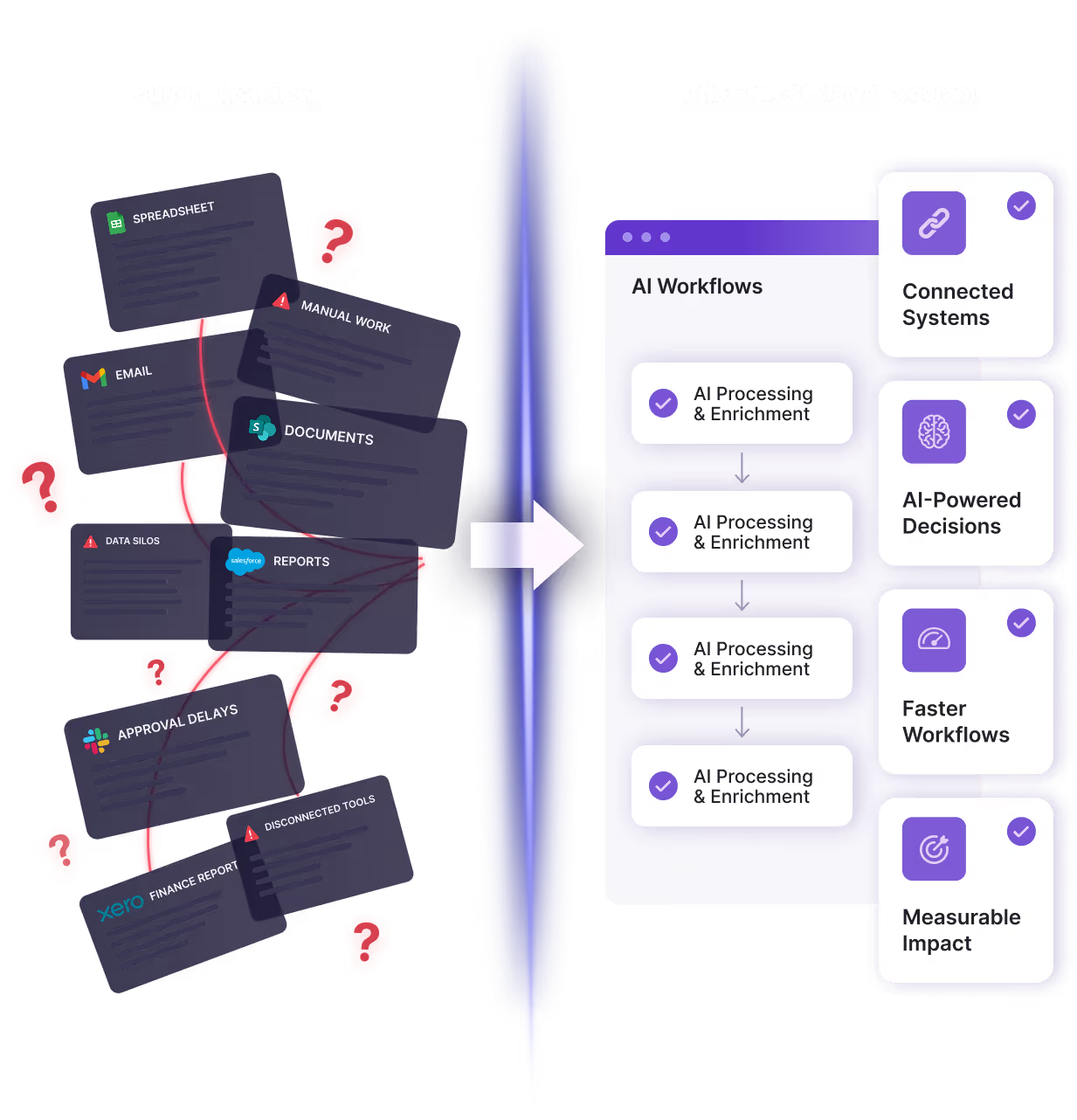
Using AI, But Not Seeing Measurable Impact?

Most companies are already experimenting with AI. But the impact often stays trapped in individual tools, isolated use cases, and ad hoc habits.Without a clear implementation plan, AI rarely turns into measurable efficiency, better decision-making, or business ROI.

Manual Workflows

Core processes still rely on repetitive, manual effort.

Fragmented Data

Information is spread across systems with no clear connection.

Slow Reporting

Insights take too long and lack consistency across the business.

Scattered AI Use

Tools are used in isolation without clear ROI or direction.

What You Will Have by the End of the Program

Clear AI Roadmap

A prioritised plan aligned with your operations and business goals.

Live AI Workflows

3–5 deployed solutions across your highest-impact processes.

Connected Systems

Data flows seamlessly between tools to enable real automation.

Less Manual Work

Reduce repetitive tasks across your core operations.

AI-Enabled Teams

Your team actively uses AI in their day-to-day work.

Measurable Results

Faster workflows, improved efficiency, and stronger output.
HOW IT WORKS

How the 90-Day AI Enablement Program Works

A structured implementation program designed to move your business from AI experimentation to operational deployment.

1
Weeks 1-2

Discovery & Design

We start by understanding how your business actually operates today and where AI can create the most value.

Analyse key workflows and operational processes

Define approval structures and decision points

Establish knowledge bases and data sources

Align on success metrics and business outcomes

Outcome
A clear, prioritised roadmap of AI solutions tailored to your business.
2
Weeks 3–5

Build

We begin building and connecting the core AI solutions and workflows.

Develop 3–5 high-impact AI solutions

Integrate with your systems (CRM, finance, internal tools)

Define workflow logic, routing, and automation rules

Test using real or representative business scenarios

Outcome
Working solutions connected to your systems and ready for live testing.
3
Weeks 6–9

Pilot

We deploy solutions into controlled environments and refine based on real usage.

Run live use cases with your team in the loop

Measure cycle times, output quality, and efficiency gains

Refine prompts, workflows, and logic

Strengthen tracking, logging, and auditability

Outcome
Validated solutions that perform reliably in real business conditions.
4
Weeks 10–12

Production

We transition from pilot to full deployment across your business.

Production-level deployment and system hardening

Enablement of teams with clear workflows and usage

Documentation and SOPs for ongoing use

Define next-phase opportunities and roadmap

Outcome
Fully operational AI-enabled workflows embedded into your business.
5
Ongoing

Maintenance

We continue to support, optimise, and evolve your AI solutions as your business grows.

Analyse key workflows and operational processes

Define approval structures and decision points

Establish knowledge bases and data sources

Align on success metrics and business outcomes

Outcome
A clear, prioritised roadmap of AI solutions tailored to your business.
CUSTOM AI SOLUTIONS

Examples of Custom AI Solutions We Implement

Every business is different, so every implementation is tailored to your systems, workflows, and team. These examples show the types of AI solutions we can design, build, and deploy during the 90-Day AI Enablement Program.

Deal Desk and Proposal Agent
Automates the proposal process from quote request to approved document.
Triggered from Salesforce, the agent pulls opportunity details, CPQ pricing, Xero billing history, and approved templates from SharePoint. It drafts the proposal, checks pricing and terms against approval rules, flags exceptions, and routes only what needs approval to Finance or Legal.
Once approved, it prepares the final proposal for rep review and sends it to DocuSign.
Outputs

Draft proposal

Pricing and exception summary

Approval brief

Updated CRM and document status

Expected Business Impact

Faster quote turnaround

Fewer pricing errors

Less margin leakage

Reduced internal coordination burden

Core Systems
Salesforce logo
Xero logo
Slack logo
Sharepoint logo
Docusign logo
Workato logo
Collections and Dispute Agent
Automates collections follow-up and dispute handling across overdue accounts.
Running daily, the agent pulls invoice and payment data from Xero, account ownership and customer notes from Salesforce, email history from Outlook, and supporting documents from SharePoint. It prioritises accounts by balance, age, and behaviour, drafts reminder emails, classifies customer replies, assembles dispute packs, and routes follow-up to the right owner.
Outputs

Prioritised collections worklist

Draft reminders

Dispute evidence pack

Promise-to-pay tracker

Escalation tasks

Expected Business Impact

Lower collector admin time

Faster dispute resolution

Improved collections focus

Reduced DSO pressure

Core Systems
Xero logo
Salesforce logo
Outlook logo
Sharepoint logo
Teams logo
Workato logo
Order Exception Resolution Agent
Automates order hold triage and resolution across stock, pricing, credit, SKU, and delivery issues.
Triggered by hold status, PO inbox activity, or failed EDI validation, the agent reads the order, inventory data, customer pricing, CRM notes, and approved substitution rules. It recommends the next best action, drafts the customer response, routes ownership, and tracks the order until the hold is resolved.
Outputs

Structured exception queue

Recommended resolution path

Draft customer communications

Owner assignment

Order status updates

Expected Business Impact

Faster order release

Less manual triage

Clearer ownership

Better customer communication

Core Systems
365 logo
Salesforce logo
Outlook logo
Sharepoint logo
Teams logo
Workato logo
Support Escalation Briefing Agent
Automates escalation preparation so engineering receives complete, structured context from the start.
Triggered by severity level, SLA breach, or manual escalation, the agent pulls the Zendesk thread, Salesforce account context, Datadog logs, prior incidents, and relevant knowledge articles. It assembles an escalation brief with customer impact, timeline, attempted fixes, likely issue category, and missing information. It also opens or updates the Jira issue and drafts a customer update for support review.
Outputs

Structured escalation brief

Next-step diagnostic suggestions

Draft customer update

Linked records across support and engineering

Expected Business Impact

Better engineering handoffs

Faster escalation prep

Fewer repeated questions

Quicker resolution on critical cases

Core Systems
Zendesk logo
Jira logo
Salesforce logo
DD logo
Slack logo
Workato logo
Month-End Commentary Agent
Automates finance commentary drafting so FP&A can spend more time analysing what needs action.
Triggered when close is complete, the agent pulls actuals from Xero, budget and forecast files from SharePoint, and commercial context from Salesforce. It compares results against prior periods, forecasts, and thresholds, then drafts branch-level and consolidated commentary. It also flags anomalies, identifies gaps, and sends targeted follow-up questions to managers in Teams.
Outputs

Branch commentary

Executive summary commentary

Anomaly and variance flags

Targeted follow-up prompts

Expected Business Impact

Faster reporting cycle

More consistent commentary

Reduced manual drafting

Better management attention on material issues

Core Systems
Xero logo
Excel logo
Sharepoint logo
Salesforce logo
Teams logo
Power BI logo
Workato logo
Campaign QA Agent
Automates pre-launch campaign checks across content, audience logic, routing, compliance, and webinar setup.
Triggered when a campaign is marked “Ready for Review” or enters its launch window, the agent reviews campaign assets, forms, workflows, audience rules, webinar settings, Salesforce routing, and approved disclaimer libraries. It checks consistency against the campaign brief, flags issues, suggests fixes, and sends a launch-readiness report to marketing and compliance.
Outputs

Launch-readiness report

Ranked issue list

Recommended fixes

QA and approval record

Expected Business Impact

Lower QA effort

Fewer post-launch corrections

Reduced compliance risk

Better campaign readiness

Core Systems
Hubspot logo
Salesforce logo
Sharepoint logo
Zoom logo
Slack logo
Workato logo
Contract Review Prep Agent
Automates contract intake and first-pass review preparation so Legal can focus on actual risk and negotiation.
Triggered when a contract is uploaded to the CLM workspace or a deal moves to “Legal Review,” the agent identifies the document type, extracts key clauses and metadata, pulls commercial context from Salesforce, retrieves fallback language from SharePoint, and checks prior negotiated positions. It then prepares a deviation matrix and issue summary for counsel.
Outputs

First-pass review pack

Clause deviation summary

Fallback language suggestions

Structured contract metadata

Expected Business Impact

Faster first-pass review

More consistent playbook use

Less senior legal time spent on prep work

Core Systems
Salesforce logo
Docusign logo
Sharepoint logo
Slack logo
Workato logo
Deal Memory & Investment Brief Agent
Automates deal knowledge capture and brief creation so teams can move faster with better continuity.
Triggered when a deal workspace is created, new documents are added, or a fresh brief is requested, the agent reads investment notes, emails, diligence files, meeting summaries, prior memos, and decision logs. It builds a current deal view, summarises thesis and risks, tracks open diligence items, and produces a structured investment brief with citations back to source materials.
Outputs

Current deal brief

Thesis and risk summary

Open diligence tracker

Handoff note with source references

Expected Business Impact

Less time spent reconstructing context

Stronger continuity across the team

Faster brief preparation

Lower risk of key information being lost

Core Systems
Microsoft Edge logo
Outlook logo
Sharepoint logo
Teams logo
Claude logo

Built Around Your Existing Tools and Infrastructure

We integrate AI into the systems your team already uses, so the solution fits into your business instead of forcing your business to change around the solution.

Slack logo.
Microsoft Teams logo with a stylized T and abstract shapes in shades of purple and blue.
Gmail logo with red, blue, yellow, and green colors.
Microsoft Outlook logo featuring a stylized blue envelope with an overlapping blue square displaying a white letter O.
Google Calendar icon with the number 31 in the center on a multicolored background.
Salesforce company logo with white text inside a blue cloud shape.
HubSpot
Zendesk logo
Blue square with rounded corners featuring a black stylized smiley face and vertical bars resembling a microphone or speech marks.
ServiceNow company logo in dark text with 'now' highlighted in white on green circle.
SAP company logo with white letters on a blue and black background.
Oracle NetSuite logo.
QuickBooks logo with stylized lowercase 'qb' in white on a green circular background.
Xero company logo in white text on a blue circular background.
Logo with a white letter W and an orange curved line above it on a blue circular background.
Google Drive logo.
Microsoft SharePoint logo with an 'S' on a teal overlapping circular background.
Blue abstract curved shape logo with two mirrored elements forming an X-like figure.
Notion app logo showing a stylized black letter N on a white cube.
Microsoft Excel logo with a stylized white X on a green square background.
Jira logo featuring stylized blue arrows and the word 'Jira' in dark blue letters.
GitHub logo in black and dark gray.
Asana logo
monday.com company logo with red, yellow, and green shapes.

Why our program is successful

Most AI initiatives fail to deliver meaningful impact because they stay at the level of tools, experiments, or isolated use cases. This approach is different. It is designed to move from fragmented usage to operational implementation.

Workflow-First, Not Tool-First

We start with how your business operates, not tools. By focusing on real workflows, we apply AI where it reduces friction and improves outcomes.

Workflow with a trigger 'Received an email' connected to an action 'Register user' labeled Employee Handoff, both marked completed.

Built Around Your Existing Systems

AI only works when connected. We integrate with your CRM, finance tools, and systems so solutions fit naturally into your workflows.
Flowchart with three connected steps: Personalize Reply with a woman’s photo, AI Chat Assist with a chat icon, and Deliver Quick Solution with a checkmark icon.

Structured, Time-Bound Delivery

Open-ended AI projects fail. This is a focused 90-day program with clear scope, milestones, and measurable outcomes that drive real progress.

Diagram with a central node connected to four rounded rectangles labeled Send Notice, Collect Docs, Track Reads, and Update Log, each with an associated icon.

Human-in-the-Loop by Design

Not everything should be automated. We design solutions with approvals and checkpoints so your team stays in control while reducing repetitive work.

Circular diagram showing 'Agent' in the center with four surrounding stages: Planning, Execution, Refinement, and Interface, connected by arrows in a clockwise flow.

Built for Adoption, Not Just Deployment

AI projects fail due to poor adoption, not tech. We build workflows your team actually uses and embed them into daily operations.
Line graph showing monthly active members increasing from about 500 in February 2024 to over 5500 in July 2024.

From Use Cases to Operating Model

We don’t build isolated tools. We create a foundation for ongoing AI adoption with a repeatable approach to building and scaling solutions.
Revenue graph showing an upward trend with highlighted value of $8,420 and a note of +310 from last week.

Designed for Businesses Ready to Operationalise AI

This program is best suited for companies that:

Have 50 to 500+ employees

Operate across multiple systems, teams, and workflows

Are already experimenting with AI but lack structure

Want to move from isolated use cases to implemented solutions

Have clear operational bottlenecks worth solving

Can assign an internal owner to support implementation

Next steps

1.

Book a strategy call

We’ll understand your business, systems, and current AI maturity.

2.

Align on opportunities

We’ll discuss where AI could create the biggest operational impact.

3.

Receive a tailored proposal

You’ll receive a clear plan for scope, timeline, and solutions.

4.

Begin implementation

Once aligned, we begin the 90-day enablement program.